

Case study · Real estate · Sales history to a trained model
Asking price is not sale price. GreenifyAI shows how each listing compares with what similar homes sold for.

Written by Emanuel Castañeda
Founder & Chief Executive Officer · November 19, 2026 · Updated November 24, 2026
A home's asking price is the amount the seller wants for it. The sale price is the amount a buyer actually paid. GreenifyAI was developed to assist buyers in determining whether a home's asking price is higher or lower than the prices of similar homes that have sold. Using EasyDeploy AI, GreenifyAI has created a model with actual sale price data from their own records. Now, each listing displays a simple label: Below, Within, or Above Comparable Range. These labels are meant to assist buyers while making a competitive offer on a home. They are not official appraisals or predictions of what a home will sell for. But they do represent past sales performance for similar homes in similar areas with similar characteristics.
- +56%
- Homes labeled Above sold for less than their asking price 56% more often than homes overall: 41% against 26.5%
- 6,959
- recent home sales used to check the labels
- 3 labels
- Below, Within or Above Comparable Range. No estimate and no dollar figure on the site.
The question
How does a listing price compare with the actual sale price?
Buyers see the asking price on every listing. What they cannot see is what similar homes actually sold for.
The way it works now
A simple label on every listing
GreenifyAI's model learns from final sale prices, not asking prices. Each listing shows one of three labels: Below, Within or Above Comparable Range.
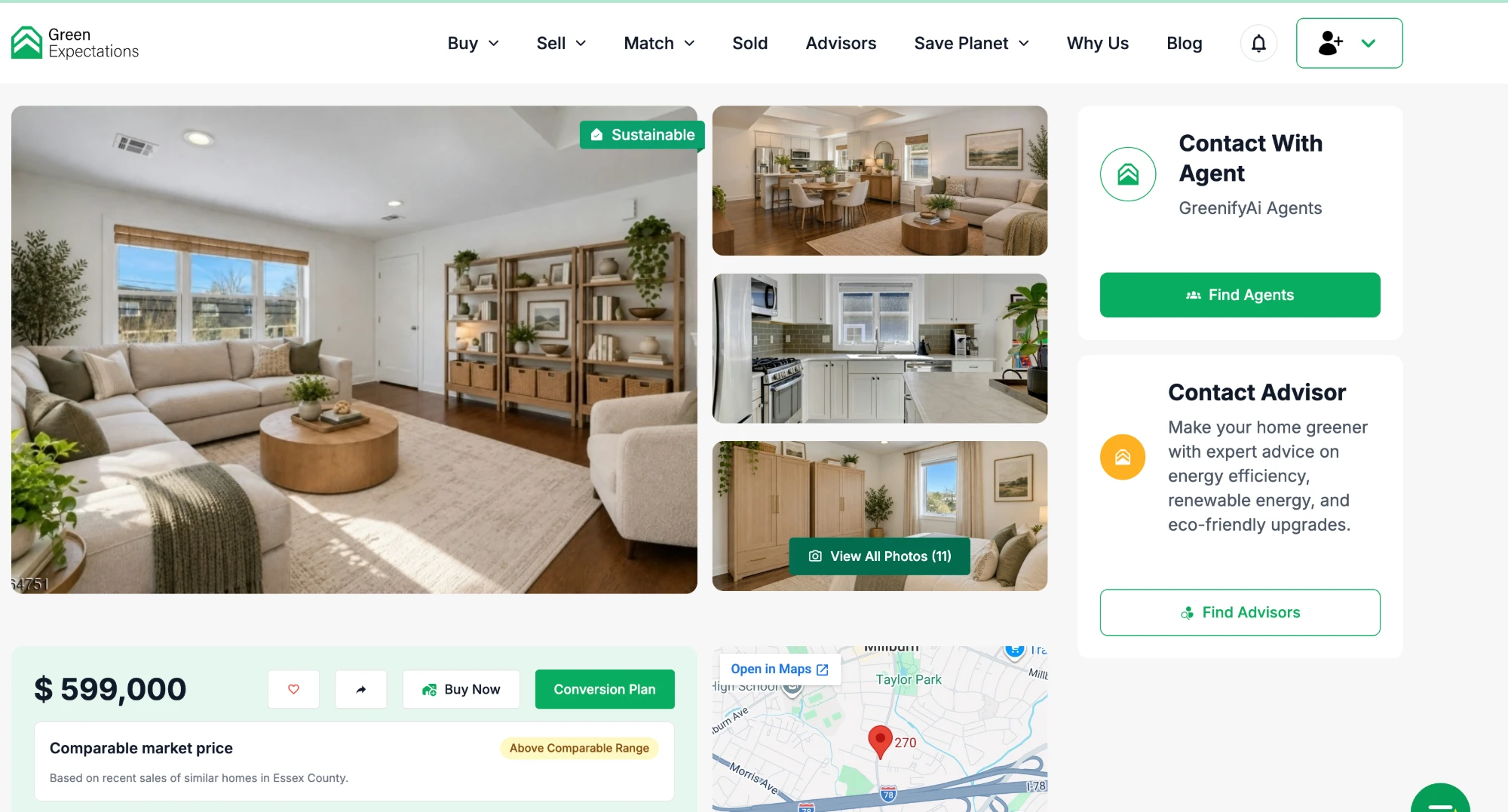
A listing page on GreenifyAI.com. The comparable-range label sits under the price, with no estimate and no dollar range.
This works in any industry. If your business keeps a record of how things turned out, such as sales closed, invoices paid or customers who left, that history is training data.
01 / The check
Checked against 6,959 recent home sales.
Before the labels went on the site, they were checked against recent sales the model had never seen. The model learns only from final sale prices. It never looks at the asking price.
Home sales checked
6,959
recent sales, kept aside so the check was fair.
Learns from
Sale prices
What homes actually sold for, not what sellers asked.
On the site
A label only
No estimate and no dollar figure is shown.
The label describes how an asking price compares with recent sales of similar homes. It is not an appraisal and not a prediction of the sale price.
02 / Result
Homes labeled Above sold for less than asking more often.
Of all the homes in the check, 26.5% sold for less than their asking price. Of the homes labeled Above, 41% did. That is 56% more often.
All homes
26.5%
sold for less than the asking price
+56%
more often
Labeled Above
41%
sold for less than the asking price
03 / Process
Three steps, start to finish.
A CSV in, a trained model out. No hyperparameter tuning, no ML engineer required.
Prepare
Past home sales from the MLS feed, with the most recent set aside to check the result.
6,959 sales set aside
Train
EasyDeploy tried many model types and settings, and kept the best one.
Automatic model search
Score
Each listing on GreenifyAI gets its label, next to the sustainability grade.
Below / Within / Above
Your history is already in a spreadsheet.
If you have records of what happened and what you knew beforehand, EasyDeploy can learn the pattern and show you how it does on rows it never saw. Bring a CSV.
The model was trained on the final sale prices of GreenifyAI's closed sales and checked against the 6,959 most recent, which were kept out of training. The asking price is not an input. Of the homes the model would have labeled Above, 41.3% sold for less than their last asking price, against 26.5% of all homes in the check, a relative increase of 56%. The check uses the last asking price before sale, so earlier price cuts are not counted. The label describes how an asking price compares with recent sales of similar homes; it is not an appraisal or a prediction of the sale price.
GreenifyAI is at GreenifyAI.com.