
How to Predict Which Deals Will Close, Using Your Own Closed Deals
Picking the biggest deals did no better than picking at random. Learning from past deals did.
By Emanuel Castañeda, Founder & CEO
November 25, 2026
Many sales teams go after the biggest deals first. In a test on a public IBM sample, 25 of the 100 biggest deals were won. Of the 100 deals a model ranked highest, 91 were won. Here's how it works, and how to test it on your own deals with EasyDeploy AI.

TL;DR
Your closed deals can tell you which open ones to chase. In a public IBM sample of sales deals, where 23 in 100 were won, the 100 biggest deals produced 25 wins. The 100 that a model picked, after learning from past deals, produced 91.
Out of 100 deals, how many were won?
Four ways to pick 100 deals from the same 19,412 test deals.
Picked at random
no sorting at all
The biggest deals
sorted by deal amount
Clients who bought in the last two years
one simple rule
The model's top picks
learned from past deals, built with EasyDeploy AI
- The model learns from your closed deals and scores each open one for how likely it is to be won. A spreadsheet export is enough to build it.
- Don't trust a score until it has beaten the way you prioritize today, on your own recent deals.
- We make EasyDeploy AI, which built the model here on its free tier.
How this model was built
1
Connect your data
A spreadsheet or your CRM, in Claude, ChatGPT, Gemini or Copilot
2
Connect EasyDeploy AI
The connector that lets the assistant train models
3
Train a model
Say in plain words what you want to predict
4
Run predictions
Score new rows and check them against what happened
- Connect your data. We gave Claude a public IBM file of 77,646 closed deals for car parts and accessories.
- Connect EasyDeploy AI. EasyDeploy AI is what learns from the deals. ChatGPT, Gemini and Copilot connect the same way.
- Train a model. Claude asked for a model that predicts won or lost. It took about an hour.
- Run predictions. The model scored 19,412 deals it had never seen.
What predicts whether a deal will close?
Mostly things you already record. EasyDeploy AI shows a chart, called feature importance, of what the model leaned on most.
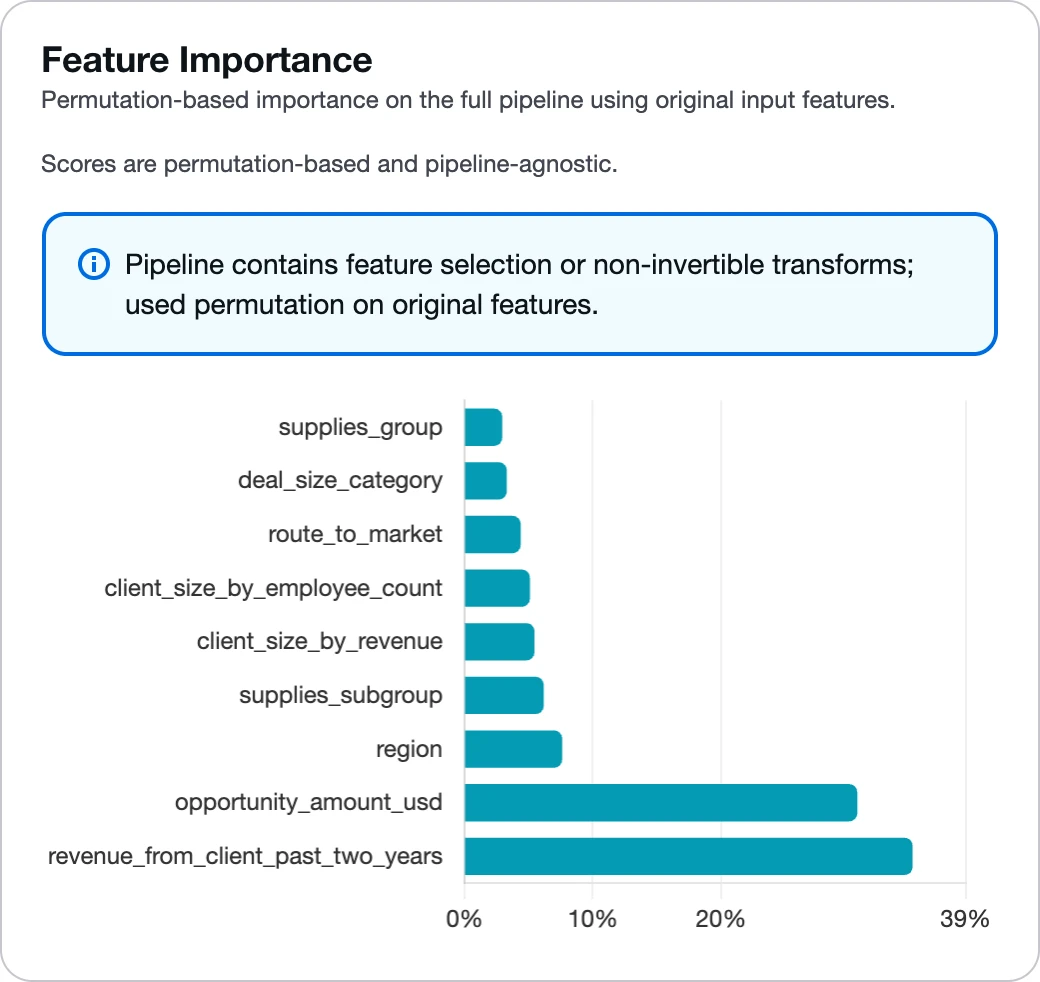
Past spend and deal size did two thirds of the work. Of every 100 deals with a client who had bought in the last two years, 64 were won, against 17 for everyone else. Bigger deals were won less often: 34 of every 100 in the smallest fifth were won, and 16 in the largest.
For technical readers: how feature importance is measured
This is permutation importance. Each column is shuffled in turn, and the drop in the model's score is that column's importance, shown as a share of the total.
Columns that carry the same information split the credit between them, and not always evenly. Deal amount and deal size band are an example. Type of competitor scored zero, so the chart leaves it out.
The win counts are across all 77,646 deals, of which 23 in 100 were won.
What about stage probability and buyer signals?
This sample doesn't record which stage a deal was in, so we couldn't test stage probability. It is a percentage someone set for each stage. By default, every deal in the same stage gets the same number, so it can't tell you which of two deals in that stage to work first.
Buyer signals are the usual advice: several contacts replying, the budget holder on a call, a dated next step. They're sensible, but nobody outside your company knows how much each one counts for you. A model can work that out from your closed deals, but only if you recorded each signal while the deal was still open.
How well can a model predict which deals will close?
In this test, far better than sorting by deal size. We hid a quarter of the deals, 19,412 of them, from the model. Then we picked 100 of the hidden deals four ways and counted the wins.
- At random: 23 won.
- Biggest deals first: 25 won.
- Clients who bought in the last two years first: 63 won. If you try one rule on your own deals, try this one.
- The model's top picks: 91 won.
With thousands of deals, what counts is how much of the list you can set aside. The top fifth of the model's list held more than half of all the wins.
How much of the list do you have to work?
Out of every 100 deals that were won, how many you reach by working only the top of the list.
Work the top 10% of the list
Ranked by the model
33
Biggest deals first
9
Work the top 20%
Ranked by the model
55
Biggest deals first
15
Work the top half
Ranked by the model
85
Biggest deals first
33
For technical readers: how the test was run
The data is IBM's Sales Win Loss sample: 78,025 rows, 77,646 after removing 379 whose opportunity number appeared more than once. We split it at random, keeping the share of wins the same: 58,234 deals for training and 19,412 held out, of which 4,369 were won.
A random split is the easier test. On your own deals, split by date, as in the steps below.
The model got ten columns: product line and group, region, sales channel, amount and size band, two client size bands, revenue from the client in the past two years, and competitor type.
ROC AUC on the held-out deals was 0.50 for random order, 0.38 for biggest first, 0.63 for clients who bought in the last two years first and 0.83 for the model. In the first 1,000 deals the counts were 225, 227, 626 and 851.
Many deals tie on amount or on client history, so those two rows are averages over 400 random tie-breaks.
The 19,412 held-out deals had 4,369 wins. Ranked by the model, the top 10% held 1,456 of them, the top 20% held 2,388 and the top half 3,711. Ranked by amount, the shares were 9%, 15% and 33%.
Training took about an hour for each model on EasyDeploy AI's free tier. Scoring the 19,412 held-out deals took under ten seconds.
What should you keep away from the model?
Anything you only know once the deal is over, like how long it took or why you lost it.
Known at the start: give these to the model
What you knew when the deal was opened
Product line
Region
Who is selling
Deal amount
Client size
Whether the client bought recently
Whether there’s a competitor
every open deal has these too
A score you can use on open deals
Known only at the end: leave these out
What you learned when the deal closed
How long the deal took
How many times it changed stage
The final stage
Close date and close reason
an open deal only has part of these
Looks brilliant in testing, misleading on open deals
A model that sees the ending looks brilliant in testing. We gave a second model four extra fields about how each deal progressed, and all 100 of its top picks were winners. A perfect score like that is a warning sign. An open deal doesn't have those final numbers yet, so that model's scores on open deals can't be trusted.
For technical readers: the four fields, and how to use timing properly
The four fields were days from when the deal was identified to closing, days from identified to qualified, days in its sales stage and the number of stage changes. With them, ROC AUC rose from 0.83 to 0.93. This is usually called target leakage.
Timing does carry real signal. To use it, you need each value as it stood on a given day. Save a weekly snapshot of your open deals with their age and stage, and after a few months you can train on the snapshots.
How do you do this with your own deals?
Connect EasyDeploy AI to an AI assistant such as Claude or ChatGPT and give it your CRM export. Your deals are encrypted, used to train your models and nothing else, and never sold. Ask for five things, in order.
- Get the closed deals. "Export every deal we closed in the last two years, won and lost." If past spend isn't on the deal, ask for it too: "Add what each company bought from us in the two years before the deal was created." In this test it was the strongest signal.
- Remove what you only learned at the close. "Drop anything filled in when the deal closed, and anything that kept changing until then, like stage and the number of calls and emails."
- Set aside the newest deals. "Build the model from deals closed up to six months ago. Keep the newer ones for a test."
- Compare with how you prioritize today. "Of the model's top fifth of the test deals, how many were won? And of the biggest fifth?" If the model doesn't beat what you do now, keep doing what you do now.
- Score your open deals every week. "Score the open deals and list the top fifth." Bring the list to your pipeline review, and keep it to check later how it did.
How many closed deals do you need?
In our experience a few hundred closed deals will do for a model worth testing, as long as you have a fair number of both wins and losses. A few thousand is better. With fewer, start with one simple rule, like clients who bought in the last two years first.
The readiness guide covers the rest in a few minutes.
What if your CRM already scores deals?
Then use it, and test it the same way. HubSpot's deal score, on Sales Hub Professional and Enterprise plans, draws on stage and logged activity, which our test didn't have. Salesforce's Einstein Opportunity Scoring needs 200 won and 200 lost deals in the last two years before it learns from your own deals. Until then it scores with a model built from other companies' data.
Build your own if your CRM or plan has no deal score, if the built-in one ignores what matters in your business, or if you want something to measure the built-in score against. We ran that kind of comparison for Odoo's built-in score in another post.
How do you get started with EasyDeploy AI?
Connect EasyDeploy AI to your assistant from the connector page. The free tier lets you build five models and score 100,000 deals, with no credit card. If you haven't built a model from a chat before, this guide walks through a first one.
About this test
We make EasyDeploy AI, which built the models in this test. The deals come from a public IBM sample called Sales Win Loss, and IBM doesn't say how it was collected. It doesn't record each deal's stage along the way or its activity history, so your own results will differ.
Frequently asked questions
How do I predict which deals will close?
Use the deals you've already closed, won and lost. A model learns what the wins had in common, from what you knew while each deal was open. You test it on recent deals it hasn't seen, and then it ranks your open ones. In our test on a public IBM sample, a model built with EasyDeploy AI ranked 19,412 test deals and 91 of its top 100 were won, against 25 of the 100 biggest.
What is deal scoring?
Deal scoring puts a number on every open deal for how likely it is to be won, so you know where to spend time and how much of the pipeline to count on. Some scores add up points someone picked by hand. A predictive score learns from your own closed deals instead. Lead scoring is the earlier step: it ranks people before there is a deal.
How accurate is deal stage probability?
Not accurate enough to choose between deals. Stage probability is one percentage for each stage, set by a person, and by default every deal in the same stage gets the same number. It is meant to say how often deals in that stage are won. It can't tell you which of two deals in the same stage is the better bet. For that you need details that differ from deal to deal, such as the client's history, the amount and the product.
How many closed deals do I need to train a deal scoring model?
In our experience, a few hundred closed deals will do for a model worth testing, as long as you have a fair number of both wins and losses. A few thousand is better. Salesforce asks for 200 won and 200 lost deals from the last two years before Einstein Opportunity Scoring learns from your own data, and uses a model built from other companies' data until then. With fewer deals, start with one simple rule, such as clients who bought in the last two years first. With a tool such as EasyDeploy AI, you can test a model on the free tier before you decide.
Does HubSpot or Salesforce predict which deals will close?
Both have a built-in score. HubSpot shows a deal score on Sales Hub Professional and Enterprise, based on the deal's amount, dates, stage and logged activity. Salesforce offers Einstein Opportunity Scoring, a score from 1 to 99. Whichever score you use, check it against deals you closed recently. You can also build your own model from a CRM export with a tool such as EasyDeploy AI and compare the two.
What data should a deal scoring model not use?
Leave out anything you only know once the deal is over: the final stage, the close date, the close reason, how long the deal took and how many times it changed stage. A model that sees those looks very accurate in testing, but an open deal only has part of them. In our test on IBM's Sales Win Loss sample, four such fields made a model's top 100 look perfect, with 100 wins instead of 91. Its scores on open deals couldn't be trusted.
Can I use Claude or ChatGPT to score my sales pipeline?
Yes, if you connect it to a tool that builds a model from your closed deals. On its own, an assistant can read your deals, but it won't score hundreds of them the same way every week. Add a tool such as EasyDeploy AI, then tell it to learn from your closed deals and score the open ones. Gemini and Copilot work the same way.

Written by
Emanuel Castañeda
Founder & Chief Executive Officer
Emanuel started EasyDeploy AI after a decade of building the kind of prediction infrastructure only large companies could afford. At Audible he worked on the machine learning behind the recommendations that decide what millions of listeners hear next. Before that he wrote foreign-exchange trading software at BlackRock. In both places the pattern was the same: a team of specialists, a platform built from scratch, and a budget that put the whole capability out of reach of anyone smaller.
More about EmanuelReady to try it on your data?
Book a strategy demo for a walkthrough scoped to your systems, or start free and train a custom model yourself. No credit card required.