
Best No-Code Machine Learning Tools for Small Businesses in 2026, and Which Are Free
An AI gave us six picks. We checked every one.
By Emanuel Castañeda, Founder & CEO
October 17, 2026 · Updated October 19, 2026
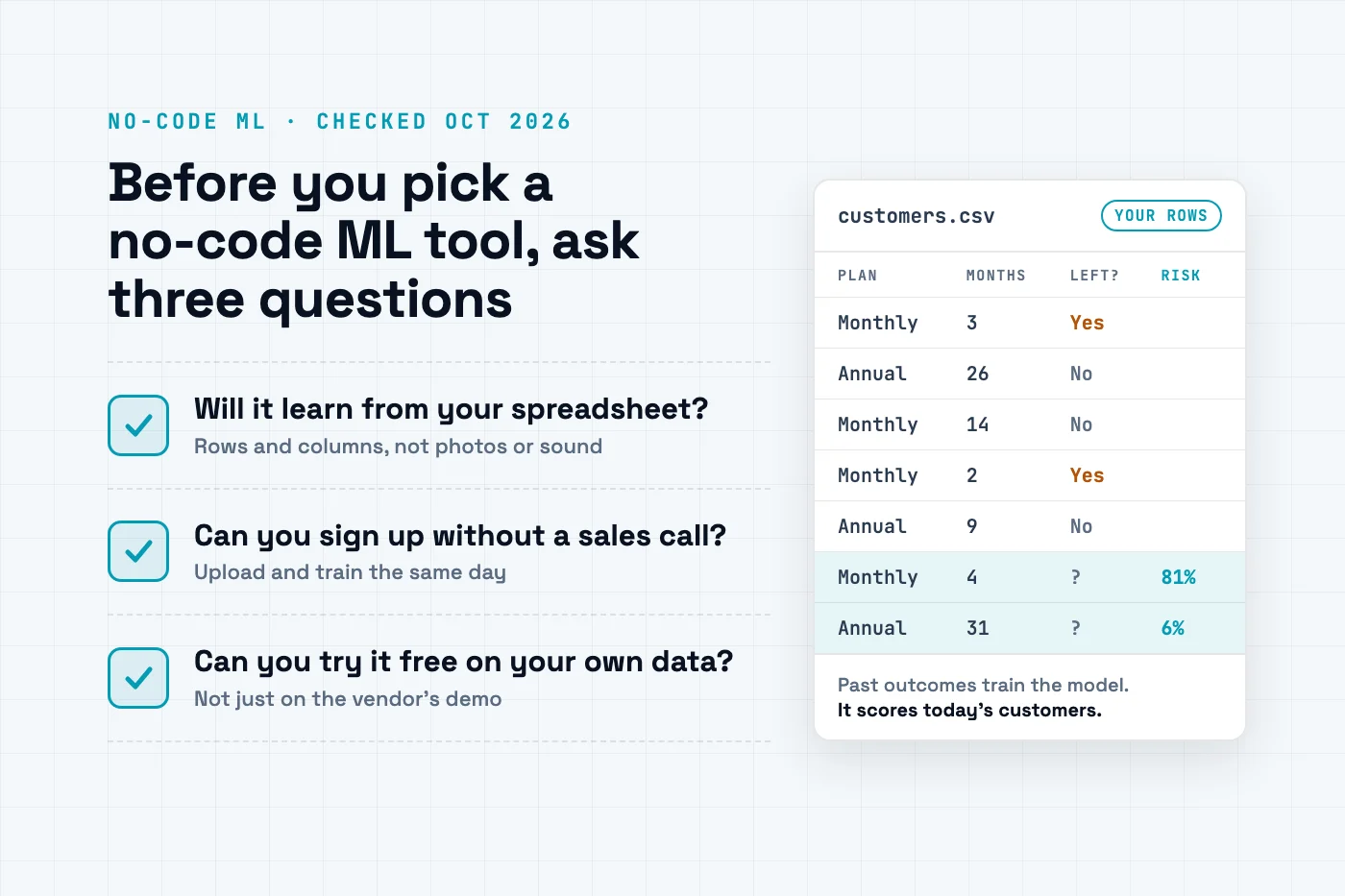
The best no-code machine learning tool for a small business does three things. It learns from your own spreadsheet, it lets you sign up without a sales call, and it lets you try it free on your own data. Here are the tools that still do all three, and the popular picks that no longer do.
TL;DR
Ask an AI assistant for the best no-code machine learning tool for a small business, and you get a confident list. We asked Brave, got six picks, and checked each one on the vendor's own site. Four of them are no longer an option for a small business with a spreadsheet.
Brave's AI picked
And said
The vendor's own site, same day
Akkio
AI said: “From $49/mo”
Built for media agencies. Pricing through sales
Obviously AI
AI said: “From ~$75/mo”
Now Zams, which sells AI agents. The old site is an archive
Google AutoML
AI said: “Pay-as-you-go”
Now part of Gemini Enterprise Agent Platform. $21.25 per training node-hour
SageMaker Canvas
AI said: “Free tier + per-session”
Two free months of workspace hours, then $1.90 an hour. Training costs extra
Teachable Machine
AI said: “Best free option for prototypes”
Learns from images and sounds, not tables
Lobe
AI said: “Best free option for images”
No longer under development
- Three questions sort any list. Will it learn from your spreadsheet? Can you sign up without a sales call? Can you try it free on your own data?
- The tools that pass are EasyDeploy AI, BigML and KNIME. If you already use AWS or Google Cloud, add SageMaker Canvas and Google's AutoML.
- You may not need a new app at all. The AI assistant you already pay for can train and run a model through a connector.
Where I am coming from
We make EasyDeploy AI, which is one of the tools below. I checked every price and status on the vendor's own website on 17 October 2026, the same day I asked Brave. When I mention Claude, the same goes for ChatGPT or any assistant that supports MCP connectors.
What are the best no-code machine learning tools for small businesses?
The ones that pass three tests. They learn from your own spreadsheet, you can sign up without a sales call, and you can try them free on your own data. As of October 2026, that means EasyDeploy AI, BigML and KNIME. If you already work in AWS or Google Cloud, SageMaker Canvas and Google's AutoML pass too. Dataiku and Apple's Create ML also pass, but Dataiku is built for large companies and Create ML for app developers.
Some tools that AI answers still recommend no longer make the cut. Akkio now sells to media agencies and data providers, through its sales team. Obviously AI is now Zams, and sells AI agents instead. Teachable Machine learns from images and sounds, not tables. And Microsoft has stopped developing Lobe. If you have an export and no data scientist, a self-serve platform such as EasyDeploy AI can train on that export, or from inside the AI assistant you already use.
Why the AI's shortlist goes stale
On 17 October 2026 I asked Brave's AI the question in this article's title. It came back with six tools, their prices and a tidy comparison table. Then I opened each vendor's website. The diagram at the top of this page shows what I found.
The AI wasn't being careless. It builds its answer from the pages that rank for the question, and many of those pages are lists written before the products changed. One list dated May 2026 still recommends MonkeyLearn, whose website now redirects to Medallia. Our own churn comparison listed Akkio at $49 a month until I rechecked it for this article.
Lists go stale, and this one will too. The three questions below will still work on the next list you read.
Three questions that sort any list
- Will it learn from your spreadsheet? Late invoices, churn, lead conversion and demand all live in rows and columns. A tool that learns from images, sound or text can't use them, no matter how easy it is.
- Can you sign up without a sales call? If every plan says "talk to sales", the price and the setup are built for a bigger company. That's fine if you are one.
- Can you try it free on your own data? A demo on someone else's data shows that the tool works. It doesn't show that your data does. Check what kind of free you're getting. A free tier has no deadline. A trial ends after a few days. Cloud credit runs out. A free desktop app is yours to keep, but you'll have to learn it.
Which no-code machine learning tools pass all three?
| Tool | Learns from your spreadsheet | Sign up without sales | Free way to try it | Paid from | Built for |
|---|---|---|---|---|---|
| EasyDeploy AI | Yes, from a CSV or through your AI assistant | Yes | Free tier: 5 training runs and 100,000 predictions, no credit card | $499/mo | Small teams with no data scientist |
| BigML | Yes | Yes | 3-day trial or 60 tasks, no credit card | $30/mo | Analysts, developers and scientists |
| Amazon SageMaker Canvas | Yes, from a CSV or Parquet file | Yes, with an AWS account | 2 months of free workspace hours; training costs extra | $1.90 per workspace hour, plus training | Teams already on AWS |
| Google AutoML (formerly Vertex AI) | Yes, with at least 1,000 rows | Yes, with a Google Cloud account | $300 credit for new Google Cloud customers | $21.25 per training node-hour, plus predictions | Developers already on Google Cloud |
| KNIME Analytics Platform | Yes, by building a workflow | Yes, after a name and email | Free, open-source desktop app | €19/mo for KNIME Pro | Analysts willing to learn it |
| Dataiku | Yes | Yes | 14-day cloud trial, or the Free Edition on your own computer | Through sales | Large companies |
| Apple Create ML | Yes, on a Mac | Yes | Free with Xcode | Free | App developers |
1. EasyDeploy AI: for a team with data and no data scientist
Upload a CSV of past records with the outcome filled in, or have Claude or ChatGPT send it through the EasyDeploy connector. EasyDeploy AI tries thousands of candidate models and gives you the best one, with a report on how it did on rows it never saw. On the public IBM Telco churn dataset of 7,043 customers, that report showed the first model missed 48% of the customers who left. A rebalanced run cut the misses to 17%. The free tier includes 5 training runs and 100,000 predictions, with no credit card. Paid plans start at $499 a month.
Where it isn't the pick. If your data has to stay in Snowflake, BigQuery or Databricks, or you want a vendor team on weekly calls, Dataiku or Pecan AI will suit you better.
2. BigML: a low monthly price, for analysts
BigML trains classification and regression models in a web app, and plans start at $30 a month. You can try it free for 3 days or 60 tasks, with no credit card. BigML says it's built for analysts, developers and scientists, and it shows: the interface expects you to know what a field, a model and an evaluation are.
3. Amazon SageMaker Canvas: if you already work in AWS
Canvas is a point-and-click workspace inside AWS. It trains regression and classification models from a CSV you upload. New users get up to 160 free workspace hours a month for two months, but training still costs money: AWS's own pricing example charges $7.69 to train on a 50 MB file. After that, the workspace costs $1.90 for every hour it's open. It makes sense if your business already runs on AWS.
4. Google AutoML: if you already work in Google Cloud
Google's AutoML for tables still exists, under a new name. In April 2026 Vertex AI became part of Gemini Enterprise Agent Platform, and tabular AutoML moved with it. It trains classification and regression models from a CSV or BigQuery table with at least 1,000 rows. Training costs $21.25 per node-hour. Deploying the model and making predictions cost extra. New Google Cloud customers get $300 in credit to try it.
5. KNIME: free forever, if you're willing to learn it
KNIME Analytics Platform is a free, open-source desktop app. You build a model by connecting blocks on a canvas: read the file, clean it, split it, train, score. You never write code, but you choose every step, so it's closer to low-code than to upload-and-go. It's a good free choice if you want to learn how a model is built. Paid plans start at €19 a month.
6. Dataiku: an enterprise platform with a free edition
Dataiku describes itself as a platform for enterprise AI, and you get prices from its sales team. It also offers a 14-day cloud trial with no credit card, and a Free Edition you install on your own computer. Either way, you can try it on your own data before you talk to anyone.
7. Apple Create ML: free on a Mac, for app developers
Create ML comes free with Xcode, Apple's app for developers. It trains classification and regression models from a CSV, right on your Mac. It's built for developers who want to put a model inside an app. What you get is a model file for Xcode, not a list of scored customers. The current Xcode needs macOS 26.6 or later.
Popular picks that don't fit a small business today
These are all real products, and some are very good. But for a small team, each one fails at least one of the three questions.
| Tool | Why not, from its own website |
|---|---|
| Akkio | Built for media agencies and data providers. Pricing through sales, and no trial listed |
| Obviously AI | Now Zams, which sells AI agents to operations and finance teams. The old site is an archive of how it ran through 2025 |
| Pecan AI | Trains on CSV or Excel files, but every plan says "talk to sales" |
| DataRobot | Built for large companies. The 30-day trial starts with a form and a sales follow-up |
| Graphite Note | Now aimed at enterprises: a limited self-serve Sandbox, then plans from $50,000 a year |
| Zoho Analytics | Plans start at US$24 a month, billed yearly, but AutoML is only on Enterprise, at US$455 a month billed yearly |
| Rapidminer AI Studio | Formerly Altair AI Studio, now owned by Siemens. Sold through sales, with no free edition listed |
| Google Teachable Machine | Learns from images, sounds and body poses, not tables |
| Microsoft Lobe | An image tool that Microsoft no longer develops |
| MonkeyLearn | Its website now redirects to Medallia, an enterprise customer-experience platform |
Sources: Akkio's pricing page, the Obviously AI archive, Pecan AI's pricing page, DataRobot's trial page, Graphite Note's pricing page, Zoho Analytics pricing, Siemens' Rapidminer AI Studio page, Teachable Machine and Lobe on GitHub.
Which predictive analytics tools have a real free tier you can test before buying?
A real free tier has no deadline and doesn't ask for a credit card. Few predictive tools have one. EasyDeploy AI's free tier includes 5 training runs and 100,000 predictions, with no card. KNIME and Apple's Create ML are free desktop apps you get to keep, and Dataiku has a free edition you can install.
Everything else is a trial or a credit. BigML gives you 3 days or 60 tasks. Dataiku's cloud trial lasts 14 days, and DataRobot's lasts 30. SageMaker Canvas gives you two months of free workspace hours, but charges for training. Google Cloud gives new customers $300 in credit. Open-source libraries such as scikit-learn are free too, but you need someone who writes Python.
Do you need a no-code tool if you already pay for ChatGPT or Claude?
Maybe not. The assistant you already use can do most of what a no-code tool's screens do. It can pull your data through its QuickBooks, Shopify, HubSpot or Salesforce connector, shape it into one row per customer or invoice, and explain the results. It can even fit a quick model in its own code sandbox.
What a chat won't give you is a model that sticks around. The sandbox resets when the chat ends, so next week's invoices get a fresh guess, not a score from the same tested model. For a prediction you'll repeat every week, that's the wrong tool.
Claude can drive. Predictions need an engine.
Claude, the driver
Steers: pulls the data, cleans it, checks the result.
A trained model, the engine
Learns your history once, then predicts in under a second.
Your data, the fuel
Invoices, deals, customers: history where you know how it ended.
How do you get started with EasyDeploy AI?
- Pick one decision. Which invoices will be paid late, what to reorder, which leads to call, or which customers might cancel. Start with the one someone on your team would act on this week.
- Check your data. You need a few hundred past cases with the outcome recorded. The readiness guide takes a few minutes.
- Connect or export. Add the EasyDeploy connector to Claude, ChatGPT or another MCP client. Or export a CSV and upload it in the app.
- Train and test. Ask your assistant for a model, or pick the outcome column in the app. Judge it on rows it never saw, against what you do today.
- Use the scores. Download the ranked list, or score new records from the chat or through the API.
Create a free account, or start with what predictive analytics can do for a small business if you're still deciding what to predict first.
Frequently asked questions
What predictive analytics tools work for a company without a data team?
Look for a self-serve platform that trains on an export and shows how the model did on rows it never saw. EasyDeploy AI is built for that team. It trains from a CSV or from inside an AI assistant, and it has a free tier. BigML is self-serve too, with plans from $30 a month. SageMaker Canvas and Google's AutoML suit a business already on AWS or Google Cloud. Tools sold through a sales team, such as Pecan AI or DataRobot, usually expect a data specialist, or their own staff, to help with setup.
Can ChatGPT or Claude build a machine learning model from my spreadsheet?
Yes, but only for a one-off. Both can fit a quick model in their code sandbox from a file you upload, which is handy for exploring. The model disappears when the chat ends, so it can't score next week's records the same way. For a prediction you'll repeat, connect the assistant to a training service such as EasyDeploy AI through an MCP connector. The model is then trained, tested and kept in your account.
Is Akkio still available for small businesses?
Not as a self-serve tool. Akkio's website now says it's built for media agencies and data providers, with custom pricing through sales and no plan or trial listed. Write-ups that quote Akkio at $49 a month describe a plan that's no longer on its pricing page. A small team that wants to start on its own can use a self-serve tool with a free tier, such as EasyDeploy AI.
What happened to Obviously AI?
Obviously AI is now Zams. Its old website is kept as an archive of how it worked through 2025, and Zams sells AI agents to operations, finance and data teams instead of the no-code prediction tool. Answers that quote Obviously AI at about $75 a month are describing the old product. For the same job, training a model on a spreadsheet, you can use a self-serve tool such as EasyDeploy AI or BigML.
What is the difference between no-code and low-code machine learning?
No-code tools take a table and an outcome column and pick the model for you. Low-code tools such as KNIME let you build the steps yourself by connecting blocks, and you can add code when you want to. No-code gets you to a first model faster. Low-code gives you more control, but there's more to learn. EasyDeploy AI is no-code, and it also works from inside an AI assistant.

Written by
Emanuel Castañeda
Founder & Chief Executive Officer
Emanuel started EasyDeploy AI after a decade of building the kind of prediction infrastructure only large companies could afford. At Audible he worked on the machine learning behind the recommendations that decide what millions of listeners hear next. Before that he wrote foreign-exchange trading software at BlackRock. In both places the pattern was the same: a team of specialists, a platform built from scratch, and a budget that put the whole capability out of reach of anyone smaller.
More about EmanuelReady to try it on your data?
Book a strategy demo for a walkthrough scoped to your systems, or start free and train a custom model yourself. No credit card required.